Showing posts with label Australia. Show all posts
The world, as we all know, is a big place - alive with wonderful, well-known attractions.
And plenty that are far more invisible to popular perception. For every New York there is a canyon in a corner of Colorado which barely raises a flicker of recognition outside the state. For every crowded marketplace in Marrakech there is a mountain-framed mosque far from the beaten track in rural Morocco. For every Tokyo skyline, there is a Japanese island awash with art, utterly aloof to the noise of the capital.
The images in this gallery represent 15 such places – from the jungle-shrouded back-waters of the Far East to the sandy coastline of Mozambique via the hard edge of Western Australia.
Know some of them already? Then count yourself as a well-informed, questing traveller. Unaware of many of them? They are all waiting to be discovered...
Read the first part of our guide here
--
1. Gunung Mulu National Park (Malaysia)
Gunung mulu
Tucked into the north of Sarawak – the largest Malaysian state on the rainforest-shrouded island of Borneo – Gunung Mulu National Park is home to one of the world’s most spectacular cave systems. In particular, it is home to the Deer Cave (see above), a colossal rock-framed corridor which is ranked among the biggest cave passages on the planet. You could store a fleet of 747s within – but the main residents are the wrinkle-lipped bats who emerge from the main cavern mouth every evening at dusk – and set off, en masse, to find their dinner.
2. Ninh Binh Province (Vietnam)
Ninh Binh province
Pinned to the north of Vietnam, 60 miles south of Hanoi, Ninh Binh Province is an antidote to the crowded confines of Halong Bay. It deals in similar wonders – limestone scenery, lonely karsts rising from the water – but without a million tour boats chugging into the picture. Most striking, perhaps, is Tam Coc canyon, where cliffs and caves are laid out for photogenic reflection along the slow-moving flow of the Ngo Dong River.
3. Aoshima (Japan)
Aoshima
One of Japan’s hidden secrets, the little isle of Naoshima lies just south of the main island of Honshu (roughly equidistant between Hiroshima and Osaka). It is famed for its love of art, to the extent that intriguing sculptures – polka-dot patterned pumpkins among them (see above) – dot the landscape. The Chichu Art Museum, meanwhile, has a surprising range of works by Claude Monet – a long way from the gardens of Normandy which inspired him.
4. Miho Museum (Japan)
Miho museum
Another Japanese wonder, this remarkable institution lies in the town of Shigaraki, near Kyoto. It houses a collection of Western and Asian antiques garnered by textile heiress Mihoko Koyama – but the museum’s most striking facet is its design. It was crafted by the Chinese-American architect I.M. Pei – who effectively injected it into a mountainside. Three quarters of the building is cocooned within rock – large glass walls and a transparent roof allow light to penetrate. A hint of Bond-villain lair? Perhaps – although this is a spectacular structure which should certainly be spared 007’s destructive urges.
5.Kimberley region (Australia)
Kimberley region
Australia has its iconic moments – Sydney Opera House, Uluru, the Great Barrier Reef. This we know. But it also has its areas of thrilling remoteness – of which the Kimberley region is certainly one. Roughly three times the size of England, the northernmost portion of Western Australia is difficult to reach – it is a long way from just about anywhere you may decide to drive from. But it rewards those who make the effort to see it in a series of stark landscapes – low-slung mountain ridges, steep-sided canyons, sullen rivers like the Ord and the Fitzroy flowing through a cracked landscape. It also has the Bungle Bungles (known as the Purnululu range by the indigenous Kija people) – rounded lumps of rock, kindred spirits to Uluru, which form the centerpiece of Purnululu National Park.
6.Black Canyon of the Gunnison (USA)
Black Canyon
Deep in the wilds of Colorado lies Black Canyon of the Gunnison National Park. Like a mini version of the Grand Canyon, it has sheer walls of grey stone that plunge more than 2,700ft to the thundering Gunnison river – a great fissure so narrow in places that sunlight only reaches to the bottom at midday. Above, ravens and golden eagles float and dip on the thermals. According to the National Parks website, the canyon contains some of the steepest cliffs and oldest rock-faces in North America – yet even in peak season, you may see no other visitors and no RVs. There are marked trails along the north and south rims, and experienced, fit climbers can risk the long scramble down to the inner canyon.
7.Marfa (USA)
Marfa
Very much the USA’s no-nonsense state, Texas is not a corner of America where you expect to find artworks on the side of dusty highways. So Marfa is a surprise to most visitors. Hidden in the Chihuahuan Desert just 60 miles from the Mexican border, this one-horse railroad town was revitalised in the Eighties by New York artist Donald Judd – who used it as a canvas for his minimalist vision. Cue a series of sculptures and installations, as well as a contemporary art museum, the Chinati Foundation, which make the town a hotspot of visual culture. That all of this exists in a slice of desert that Spanish explorers called El Despoblado (“The Uninhabited”) makes Marfa all the more exotic.
8.Scotts Bluff National Monument (USA)
National monument
Nebraska rarely tops the must-visit lists of even the most devoted of US-obsessed wanderers. But it calls to those who love the more rough-shod contours of the American landscape in the form of this grand ridge of rock, which rears to 800ft (240m) above the plains of this less-known state. Utterly majestic, Scotts Bluff might be described as a lost shard of Monument Valley. You can climb to its summit and peer out across a vista that only true Americanophiles ever see, with the North Platte River winding along far below.
9.The Rupununi region (Guyana)
Guyana
South America is blessed with numerous landmark moments – and even in Guyana, the Rupununi region is lost behind the splash and crash from the country’s most famous site, Kaieteur Falls. But, tucked into the south-west of this little nation, close to the border with Brazil, this expanse of savannah and wetland deserves closer inspection. Not least for the graceful – yet enormous – Victoria Amazonica lilypads which decorate the surface of the Rupununi River, and the otters who swim playfully between these saucers of green.
10. San Agustin Archaeological Park (Colombia)
San Agustin Park
Slotted into the south of Colombia, in Huila department, San Agustin Archaeological Park was granted Unesco World Heritage status in 1995 – and with good reason. It spreads out as an enclave of grassy clearings, dotted with excavated tombs which may be almost two millennia old. Who was buried here is a mystery – this unnamed Andean civilisation had vanished long before the Spanish conquest of South America in the 16th century. All they left were the “tomb guardians” who protected them in death – slabs of stone carved with faces that, though human, also have the features of birds and jaguars.
11. Los Haitises National Park (Dominican Republic)
Los Haitise National Park
The Dominican Republic stands as a mystery to many travellers – with even those who make it to what is the eastern half of the second biggest island in the Caribbean (behind Cuba) being restricted to the beaches of Punta Cana by an absence of viable transport links. Pinned to the north-east coast, Los Haitises National Park can only really be accessed by boat on an official guided tour – but it seduces those who discover it with lonesome rock formations and lush mangrove swamps. This is "Hispaniola" as Columbus found it in 1492.
12. Ibo Island (Mozambique)
Ibo Island
Part of the Quirimbas archipelago – a cluster of islands which dots the Indian Ocean, just off the long eastern edge of Mozambique – Ibo was once one of Portugal’s main footprints in Africa. Then the colonial era collapsed in 1974, and this distant outpost was left marooned by the tide of history. Four decades on, its churches, forts and homes are sun-bleached and fragmented – though some of them are being reconditioned as boutique hotels, as Mozambique struggles away from a difficult past into a more promising present.
13. Ruaha National Park (Tanzania)
Ruaha National park
This glorious expanse of epic vistas and noble wildlife is the largest national park in Tanzania – but it suffers from a lack of profile when placed alongside Serengeti National Park and the annual spectacle of the Great Migration. No matter. Those who venture to this sublime slice of land at the heart of the country – feasible to reach by road, but most easily accessed via the Jongomero airstrip – find a place where elephants roam amid the howls of wild dogs and the calls of more than 500 bird species. That the Great Ruaha River – which dissects the park, often runs dry in parts – only adds to the area’s dusty majesty.

14. Andy Warhol Museum of Modern Art (Slovakia)
Andy Warhol museum
You expect to encounter one of the 20th century’s most revered artists in New York, where his Factory studio was a creative whirlwind. You know you can find him in his birthplace, Pittsburgh, where the Andy Warhol Museum (warhol.org) salutes the city’s most famous son. But a town in Slovenia? Medzilaborce has a link to Warhol in that his mother, Julia Warhola, was born 10 miles away in the village of Mikova. It embraces the connection in style via the Andy Warhol Museum of Modern Art, set up by the icon’s family in 1991. It has a fine collection of his works, including a raft of Marilyn Monroe prints (see above).
15. Tin Mal Mosque (Morocco)
Tin Mal Mosque
Concealed in the High Atlas mountain range – alongside the serpentine road which leads from Marrakesh to Morocco's desert south – lies the Tin Mal Mosque. This is a roofless ruin of a place of worship built in 1156 to commemorate the founder of the Almohad dynasty. The keeper will unlock it for you – it is one of only two mosques in Morocco that non-Muslims may enter. Inside, you will find intricate plasterwork and sculpted ceilings that hint at the glorious building this once was. It is just 60 miles (100km) from Marrakesh, but most tourists never come this far. Be one of the few who do.

Source:Telegraph

Getting a Vietnam Visa on Arrival from Australia

Australian passport holders willing to visit Vietnam either for tourist or business purpose can easily obtain for a Visa on Arrival, regardless of traditional way that applicants should refer to the embassy and submit passport and other documents and waiting for 5 days to get a visa to Vietnam, then Visa on Arrival is the most simple way to get your Visa to Vietnam done, please follow the simple steps as following in order to apply online for a Visa to Vietnam.

How is the process of Vietnam Visa on Arrival?

Applicants must follow the three simple steps to submit their request in order to apply for an Approval letter; here is the process one-by-one:
  1. Browse through Tonkin Visa official and recognized Visa website (VisaVietnam.Pro) Fill in the Visa application form using the correct information as shown on your passport, applicants are required to submit the accurate information in order to get the approval letter approved by the Vietnam Immigration department.
  2. Please kindly make sure about information you’ve been submitted, afterward, move to the second step to submit the Visa services fee, this process can be done using your credit card through the online form in our website.
  3. We review your submission and start the process to get your Vietnam Visa Approval letter, the visa processing is depend on your selected options out of 3 options ( Normal for 2 days , Urgent for 1 day, Express for 4 working hours)

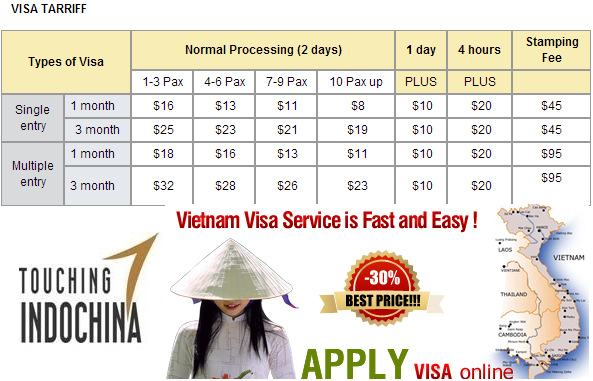
How About the Cost of a Vietnam Visa on Arrival for Australian? ( Apply with Tonkin Visa)

One Month Single Entry Tourist Visa: 16 US$
Three Month Single Entry Visa: 25 US$
One Month Multiple Entry Tourist Visa: 18 US$
Three Month Multiple Entry Visa: 32 US$
www.visavietnam.pro

We at Tonkin Visa, have special prices for Our Visa services fee for group travelers

I got the Approval letter, what’s next?

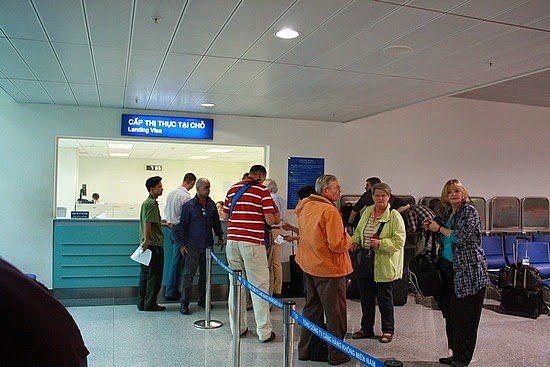
Once we sent you the approval letter, then simply print it out and present it for boarding the flight (need it), then upon arrival at Vietnam’s International Airports, you should present the visa approval letter with 1 passport sized photo and filling a visa form and present it to the Visa officers, you should pay the Stamping fee as 45 US$ for one month and 95 $ for 3 month Visa directly to the immigration officers. And wait for few minutes to get your Vietnam visa stamped into your passport. That’s it and welcome to Vietnam.

Free of charge Visa to Vietnam

We at Touching Indochina Travel (Tonkin Visa), offers Free Vietnam Visa for applicants who takes 4 days and more Tours with us, please check our Vietnam Package Tours and feel free to ask away your related questions.

Flight to Vietnam from USA - Australia and Europe

The Charm of Vietnam Tempting you to Visit This beautiful land? Many tourist included Vietnam to their itinerary list every year to visit the exciting charm of the land of the lotus flower, Vietnam, enjoying all the natural beauties of a South east Asian land. Whether you live in the United States, Australia, Canada, or Europe you may be thinking about how to find a Cheap Flights to Vietnam, the booking flights to Vietnam so you can enjoy the Halong Bay, the new wonder of the nature, Discover Mekong Delta, or indulge in the unique Vietnamese culture this country has to offer.

Getting started to planning your Tour in Vietnam you’ll need to start by making sure if you need a Visa to Vietnam, then start by booking flights to Vietnam, Vietnam Tours, and any special adventures you want to embark while you visit Vietnam. Taking a vacation halfway across the world can get expensive, but if you find cheap flights to Vietnam, you can save a bit of money. To make your Vietnam journey as cheap as possible, here is information on airports, airlines, and some tips to help you how to find a Cheap Flights to Vietnam.

Airports you may land in: As you’re planning your flights to Vietnam, you’ll find there are several airports that you can land in. Many of the most popular flights fly into Hanoi (Noi Bai Airport) or HCMC (Tan Son Nhat Airport) (recommended by Todo Travel). However, you can find flights that will land in Danang Airport as well. In most cases, you’ll want to choose the airport that is closest to your destination. Just keep in mind that you may be able to get a cheaper deal by choosing a different airport to arrive at.

Airlines that fly to Vietnam: Various airlines fly into Vietnam and you may want to consider your options as you’re trying to book cheap flights to Vietnam. If you want to fly with a national carrier, Vietnam Airline is the most popular option. However, many other Airlines fly into airports of Vietnam, Check with the airport you plan to fly out of to see what Airlines fly from your home airport to Vietnam.


Visit at the right time: If you want to get a cheap deal on flights to Vietnam, one of the best tips to follow is to visit Vietnam at the right time. The peak season is usually considered to be between the late January or early February, that’s the time when the `Tet’ New Year is celebrated all over the Vietnam, This offers you a fairly broad timeline for travel to Vietnam if you want to travel during the peak season, which makes it easier to find a flight that is reasonably priced. Well, flights to Vietnam may be cheaper during the wet season as well. Many tourists choose not to visit Vietnam during the wet season.

Book your flights to Vietnam well in advance: Another important tip to remember as you’re looking for cheap flights to Vietnam is to book far in advance. If you wait too long to book your flight to Vietnam, you’ll end up paying premium prices. It’s recommended that you book flights at least a month in advance to save money. However, if you book even sooner than that, you may be able to save even more money.

Try to fly on weekdays: You may be surprised to find that flying on weekdays can help you save money when booking your flights to Vietnam. Flights going out or arriving on the weekend are always going to be more expensive. Try booking during the week if you can work it out. Being flexible can also help. When checking flight prices, you should check a few days either way of your departure date. Simply departing a day or two later or a couple of days in advance may help you to save a substantial amount of money. Just a little flexibility can lead to some great savings.

Using online price comparison sites: One of the greatest tips on how to book a cheap flight to Vietnam is to use online price comparison sites. Today it’s easy to find travel comparison sites on the web. Sites like Momondo.com, CheapTickets.com, and others allow you to compare prices among different airlines. You can enter your travel information and then within minutes you’ll find out who will give you the best deal on the flights you need to book. Companies are competing for your business and comparison sites allow you to find out who offers the most competitive price. Within minutes, you can have the cheap flights to Vietnam.

Visiting Vietnam can be affordable to you. With the right information on your side, you can find flights to Vietnam that will easily fit into your budget. In fact, if you combine these tips together when booking a flight to Vietnam, you’ll be able to save a large amount of money. Enjoy spending that saved money on your tour to Vietnam or save it for the next trip you decide to take.


Gallery